
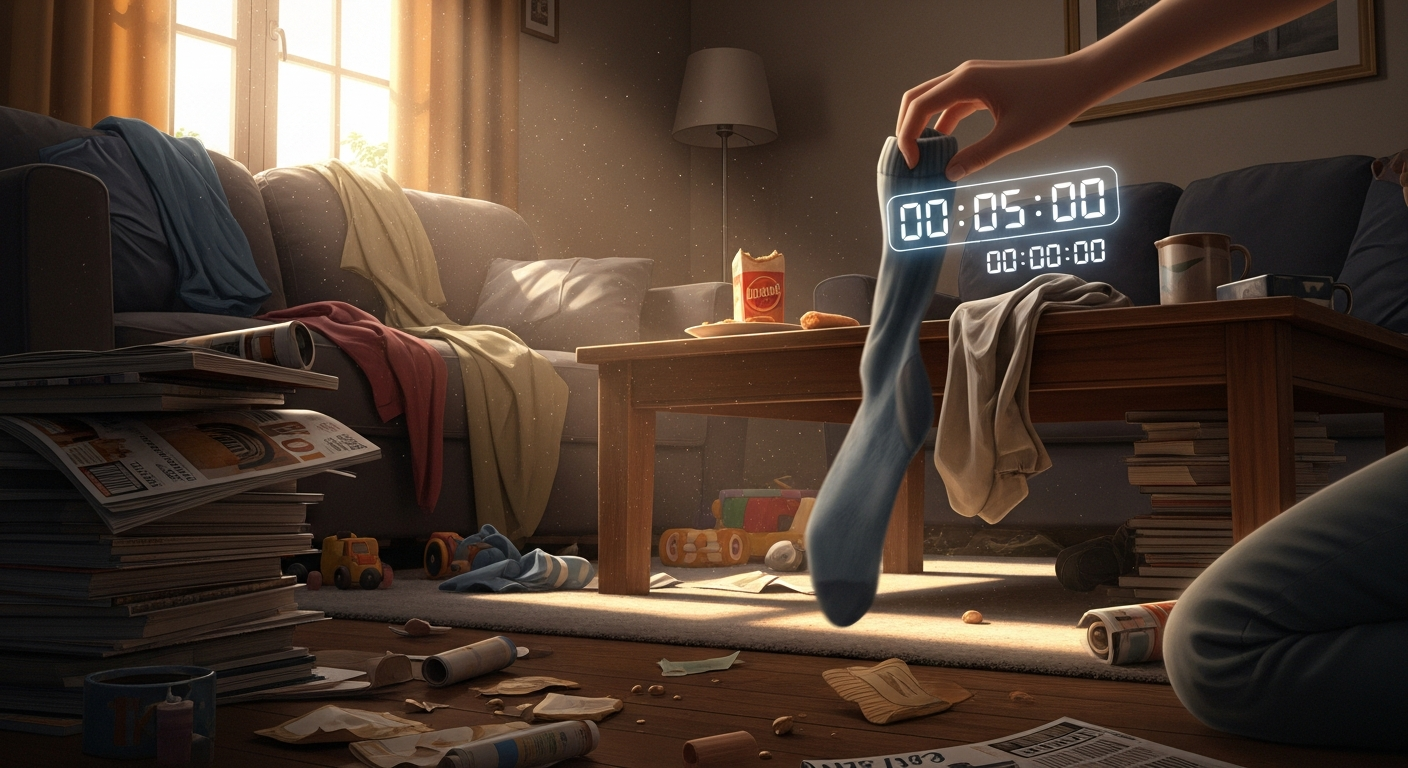
Somewhere in the suburbs of Minneapolis, Elaine Hoffman stands in her immaculate living room, a space that could easily grace the cover of Architectural Digest. ‘It’s not about having time,’ she explains, cradling a mug of tea. ‘It’s about having systems.’ Hoffman, a mother of three who works full-time as a hospital administrator, isn’t employing a cleaning service or spending her weekends scrubbing. Instead, she’s one of a growing cohort of homeowners who swear by the ‘5-Second Rule’—not the dubious hygiene principle that allows you to eat food dropped on the floor, but rather a behavioral psychology hack that’s transforming how we maintain our domestic spaces.
This rule has nothing to do with dropped cookies and everything to do with the psychology of procrastination. The premise is deceptively simple: if you see something out of place, and it would take less than five seconds to fix it, do it immediately. No exceptions, no delays. The cumulative effect of this micro-habit, practitioners claim, is a consistently orderly home that never requires the dreaded marathon cleaning session.
The Psychological Architecture of Clean Spaces
The 5-Second Rule taps into what behavioral scientists have understood for decades: our environments profoundly shape our mental states, yet we often feel powerless to control them. Dr. Elizabeth Carter, environmental psychologist at Columbia University, explains, ‘The relationship between humans and their living spaces is bidirectional. A chaotic environment creates cognitive overload, which in turn makes us less capable of addressing that very chaos. It’s a feedback loop that the 5-Second Rule elegantly disrupts.’
What makes this approach distinctive from other cleaning methodologies is its focus not on scheduled cleaning sessions but on immediate, almost reflexive responses to environmental disorder. While Marie Kondo asks us to consider whether objects spark joy, and Swedish death cleaning encourages us to discard items others wouldn’t want to handle after our demise, the 5-Second Rule sidesteps philosophical contemplation entirely. It’s purely tactical.
‘Most people think keeping a clean home requires large blocks of dedicated time,’ notes Dr. Carter. ‘This misconception is perhaps the greatest barrier to maintaining order. The 5-Second Rule challenges this by fragmenting the task into countless micro-actions distributed throughout the day.’
From Theory to Practice: The Mechanics of Micro-Maintenance
Implementing the rule requires a recalibration of how we perceive everyday objects and their rightful places. That magazine casually tossed on the coffee table, the jacket draped over a chair, the empty mug abandoned on a side table—each represents not just an object out of place, but a five-second opportunity.
Hoffman demonstrates this principle in real-time. As we talk, she notices a throw pillow askew on her sofa. Without interrupting her sentence about her children’s soccer schedule, she reaches over and straightens it. The action is so fluid, so integrated into her movement, that it barely registers as a separate task.
‘The beauty of it is that it becomes automatic,’ she says. ‘I’m not thinking about cleaning anymore. My hands just do what needs doing while my mind is elsewhere.’
This automaticity is the holy grail of habit formation. Neuroscientist Dr. James Cleary of the University of Michigan explains that ‘when behaviors become habitual, they transfer from the prefrontal cortex, which handles decision-making, to the basal ganglia, which manages automatic behaviors. This frees up cognitive resources for other tasks.’
The Cultural Context of Cleanliness
Our obsession with domestic order isn’t universal or timeless. Historian Dr. Margaret Levin points out that ‘the concept of the spotless home as a moral virtue is largely a 20th-century Western construction, coinciding with the rise of consumer culture and advertising.’ Early advertisements for household cleaning products often explicitly linked cleanliness to moral character, suggesting that a dusty shelf reflected not just poor housekeeping but questionable ethics.
The 5-Second Rule, then, exists within this cultural context, but offers a modern twist: rather than cleanliness as a reflection of character, it presents orderliness as a path to mental clarity and efficiency. It’s less about impressing visitors than about creating an environment that doesn’t tax your cognitive resources.
Critics argue that such approaches can feed into unhealthy perfectionism. Psychotherapist Mira Kirshenbaum cautions, ‘For some individuals, especially those with obsessive tendencies, these rules can become rigid and anxiety-producing. The goal should be a functional space that serves your needs, not a showroom.’
Beyond the Living Room: Expanding the Principle
While the living room—our primary social space—often becomes the focus of such efforts, practitioners of the 5-Second Rule report that it naturally expands to other domains. Hoffman notes that her kitchen, once a perpetual disaster zone during her family’s hectic weeknight dinner preparations, now remains remarkably functional. ‘When you’re cooking and you empty a spice jar, it takes literally three seconds to throw it away instead of leaving it on the counter. It’s not extra work; it’s just work done at a different, more efficient time.’
The principle extends beyond physical spaces as well. Digital clutter—unread emails, unsorted photos, neglected notifications—can be approached with the same methodology. ‘I apply the same rule to my inbox,’ says Marcus Chen, a software developer in Seattle. ‘If I can respond to an email in under five seconds, I do it immediately rather than letting it linger.’
What emerges is not just a technique for household management but a philosophy of immediacy—a recognition that deferring small tasks rarely serves us well. The accumulated weight of postponed actions eventually becomes its own burden, one far heavier than the sum of those five-second interventions would have been.
As our lives grow increasingly complex, perhaps the most valuable insight from this deceptively simple rule is that control over our environments doesn’t necessarily require grand gestures or elaborate systems. Sometimes, it’s found in the smallest moments of decisive action—in recognizing that the space between noticing and acting can be collapsed to almost nothing, and in doing so, we might find ourselves living in spaces that feel less like ongoing projects and more like sanctuaries.