
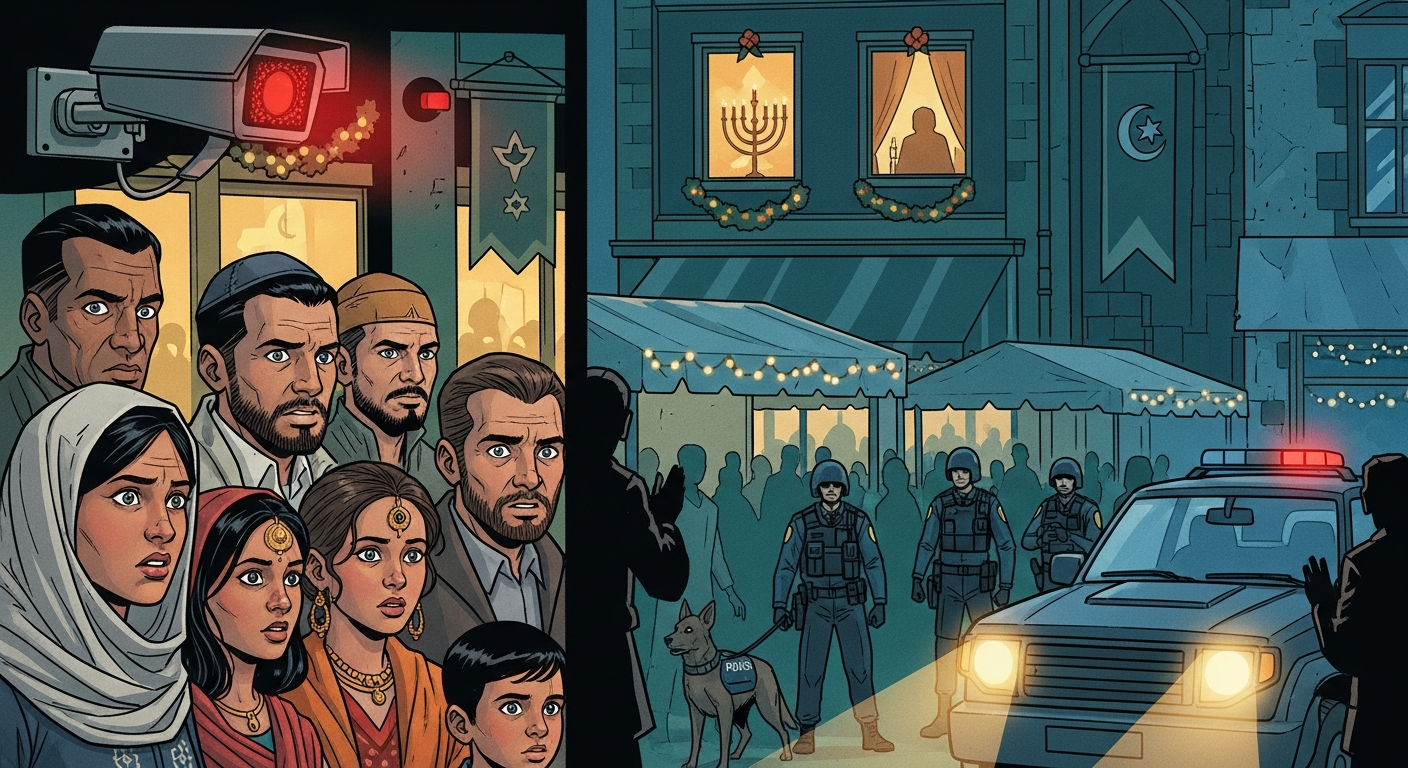
The recent warnings from Governor Tim Walz about potential ICE enforcement actions at Christmas Eve religious services represent a disturbing erosion of longstanding American principles that transcends partisan politics. When sacred spaces become targets for immigration enforcement, we’ve crossed a line that fundamentally undermines both religious freedom and community trust.
While Archbishop Hebda has received assurances that churches won’t be targeted without an imminent threat, the mere possibility has forced faith leaders to prepare defensive measures during what should be a season of peace and reflection. This represents a troubling shift in our national priorities.
Sanctuary Spaces Must Remain Protected
The tradition of sanctuary in houses of worship has deep historical roots that predate the United States itself. Churches, synagogues, mosques, and temples have long served as places where the vulnerable can find safety and compassion. ICE’s 2011 ‘sensitive locations’ policy explicitly recognized this by limiting enforcement actions at places of worship, schools, and hospitals except in extraordinary circumstances.
The suggestion that midnight masses might be targeted directly contradicts this established policy. In 2017, when ICE agents in Virginia waited outside a church to detain immigrants leaving a hypothermia shelter, the public backlash was immediate and bipartisan. Even those supporting stricter immigration enforcement recognized that tactics targeting worshippers crossed an ethical line.
Bishop Howell’s statement that faith leaders will ‘stand at the door and fight them not to come in’ reflects how deeply this potential enforcement threatens religious communities. When clergy feel compelled to physically defend their congregations from government agents, we’ve entered dangerous territory that undermines the separation of church and state.
The Calculated Cruelty of Holiday Enforcement
Governor Walz’s assessment that targeting holiday services would be ‘especially cruel’ speaks to the psychological impact of such timing. Immigration enforcement during religious holidays appears deliberately designed to maximize fear and disrupt community bonds at times of spiritual significance.
This strategy resembles the controversial workplace raids conducted on the first day of school in Mississippi in 2019, which left hundreds of children returning to empty homes. The timing of these actions suggests they’re not merely about law enforcement but about sending a message of intimidation to immigrant communities.
The psychological impact extends far beyond undocumented immigrants themselves. U.S. citizen children, extended family members, and entire congregations experience the trauma of these enforcement actions. Studies from the Urban Institute have documented increased depression, anxiety, and withdrawal among children in communities targeted by aggressive immigration enforcement.
Faith Leaders as Community Protectors
Bishop Howell’s declaration that faith leaders are ‘the greatest healers’ highlights their crucial role beyond spiritual guidance. In polarized times, religious institutions often serve as crucial social safety nets and sources of community resilience.
Religious leaders across the country have increasingly found themselves in the position of having to provide practical protection to vulnerable members. In 2018, when a Dutch church held a 96-day continuous worship service to protect an Armenian family from deportation, they demonstrated how faith communities worldwide are responding to similar pressures.
The preparation by Twin Cities faith leaders shows how immigration enforcement has forced religious institutions to develop security protocols more commonly associated with responses to violence or terrorism. When Christmas Eve services require door monitors checking for government agents with warrants, something fundamental has shifted in the relationship between religious institutions and government authorities.
Alternative Viewpoints: The Case for Enforcement
Supporters of stricter immigration enforcement argue that no location should provide blanket immunity from the law. They point to cases where individuals with serious criminal histories have used religious communities as shields against legitimate law enforcement.
This argument has merit when considering truly dangerous individuals. However, the vast majority of undocumented immigrants attending religious services pose no public safety threat. The Department of Homeland Security’s own statement to the Archdiocese acknowledges this distinction by noting they would only conduct enforcement at churches when facing an ‘imminent public safety threat.’
Others contend that deterrence requires consistent enforcement regardless of location. Yet evidence suggests that aggressive tactics primarily drive vulnerable populations further underground rather than encouraging compliance with immigration laws. A 2019 study from the Migration Policy Institute found that fear of enforcement actually decreased engagement with government institutions across the board, including those related to public health and safety.
The Path Forward: Balancing Enforcement and Values
Effective immigration policy must balance enforcement priorities with core American values, including religious freedom and family unity. When enforcement tactics target sacred spaces, especially during holy days, they undermine the moral authority of the law itself.
The solution isn’t abandoning immigration enforcement but restoring and strengthening the sensitive locations policy. By clearly establishing churches, schools, and hospitals as protected spaces, authorities can focus resources on genuine public safety threats while preserving community trust.
Faith leaders like Bishop Howell who emphasize hope over fear provide a model for addressing immigration challenges. His message to ‘come, shop, celebrate with family’ despite uncertainty reflects the resilience that has characterized American immigrant communities throughout our history.
Conclusion
When government agencies consider targeting religious services for immigration enforcement, they threaten principles far more fundamental than immigration policy. The separation between church and state, the right to worship without fear, and the role of faith communities as sources of healing and hope are all undermined by such tactics.
As this situation unfolds in Minnesota, it serves as a warning about the consequences of allowing enforcement priorities to override core constitutional and moral principles. The stance taken by religious leaders to protect their congregations isn’t just about immigration – it’s about preserving the character of American society itself.
Will we be a nation that respects the sanctity of worship, or one that allows enforcement agents to disrupt midnight mass? The answer will reveal much about what values we truly prioritize.