
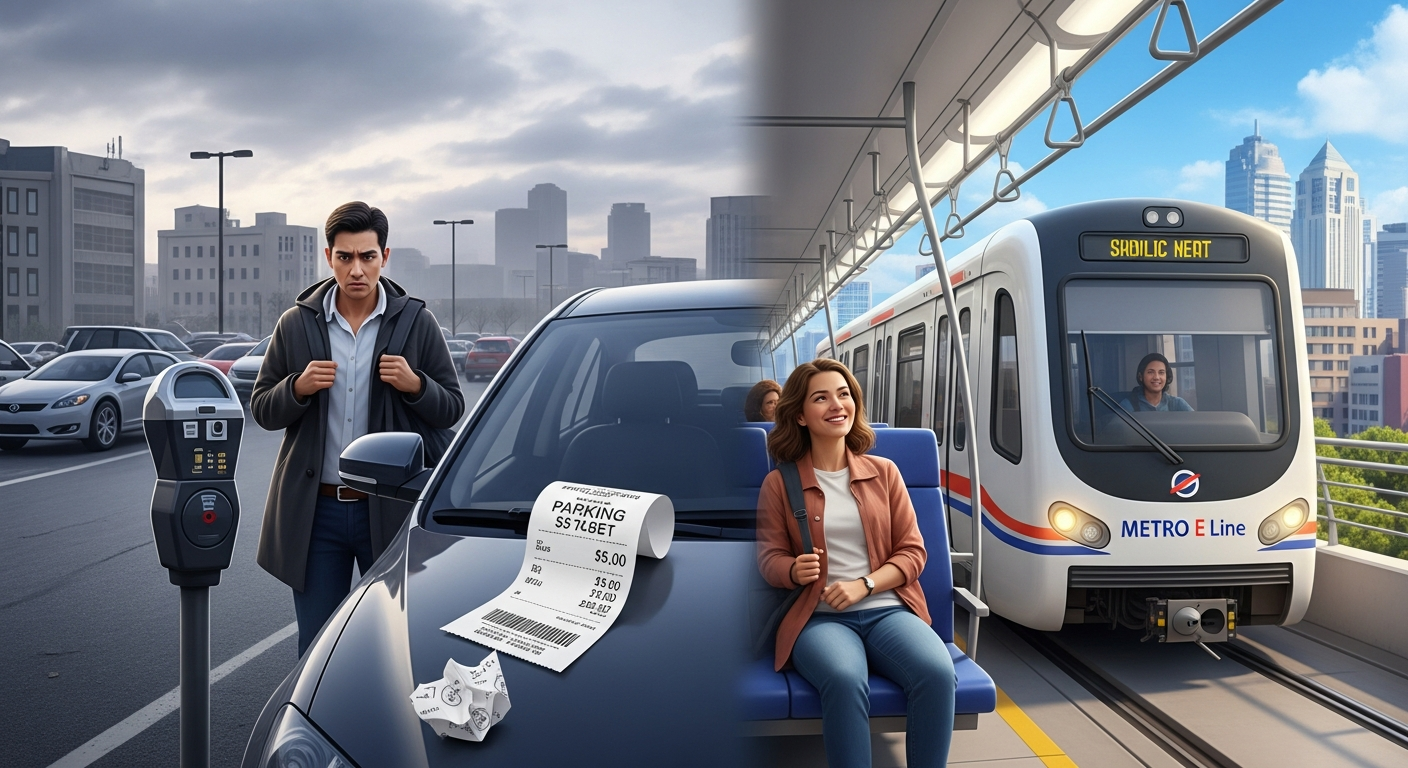
Minneapolis’s new METRO E Line represents much more than just another bus route—it embodies a crucial shift in urban transportation priorities that addresses economic inequality, environmental sustainability, and smart urban planning simultaneously. The December 6th launch of this 13-mile corridor connecting the University of Minnesota, downtown Minneapolis, Uptown, and Edina’s Southdale area deserves recognition not just for its operational metrics but for its transformative potential in a region where nearly 20% of corridor residents lack vehicle access.
While some may view the $64 million price tag with skepticism, this investment delivers extraordinary value that extends far beyond the physical infrastructure. The E Line stands as a testament to what happens when cities prioritize transit equity over car-centric development—creating lifelines to opportunity rather than just routes on a map.
Economic Mobility: Transit as an Equalizer
The Metropolitan Council Chair’s description of the E Line as a “lifeline” rather than merely a route captures the fundamental reality of public transportation in America. When nearly one-fifth of households along the corridor lack vehicle access, this isn’t simply about convenience—it’s about economic survival. The E Line connects residents to educational opportunities at the University of Minnesota, employment centers in downtown Minneapolis, and commercial districts like Southdale.
The economic impact of reliable transit extends beyond the obvious. Research from Harvard University has demonstrated that commute time serves as the strongest factor in escaping poverty—stronger than crime rates, test scores, or family structure. A 2015 study found that communities with shorter average commute times show significantly higher rates of upward mobility. By providing service from 4:30 a.m. to 1 a.m. daily with 10-15 minute frequencies, the E Line removes a critical barrier to economic advancement.
Consider the tangible difference: a single parent working evening shifts at a downtown restaurant can now reliably return home to Edina without spending a disproportionate amount of their wages on transportation. A student from a lower-income neighborhood gains consistent access to university resources without the financial burden of car ownership. These aren’t hypothetical scenarios—they represent the daily reality for thousands along this corridor.
Infrastructure That Addresses Multiple Urban Challenges
The E Line’s $64 million investment includes $11 million specifically allocated to safety and accessibility improvements—elements that benefit all residents regardless of whether they use transit. New pedestrian ramps and traffic signals create safer streets for everyone, demonstrating how transit investments generate broader community benefits.
This approach stands in stark contrast to the historical pattern of transportation spending in American cities, which has overwhelmingly favored highway expansion that primarily benefits vehicle owners. The Federal Highway Administration’s own data shows that highway expansion consistently fails to reduce congestion long-term due to induced demand, while transit investments like the E Line provide lasting capacity improvements.
The Twin Cities region has demonstrated remarkable foresight by developing a comprehensive bus rapid transit network rather than pursuing isolated projects. The E Line represents the eighth BRT line in the system and the third to open in 2024 alone, following the Gold Line (serving the I-94 corridor east of St. Paul) and the B Line (covering Lake Street, Marshall Avenue, and Selby Avenue). This systematic approach creates network effects that multiply the value of each individual line.
Environmental Impact: Climate Action Through Transit
While the press release doesn’t explicitly mention environmental benefits, they’re substantial and deserve recognition. Bus rapid transit systems like the E Line typically reduce carbon emissions by 8-10% along their corridors compared to regular bus service, primarily through more efficient operations and higher ridership.
The 60-foot buses deployed on the E Line can carry approximately 80-100 passengers at capacity—potentially removing dozens of cars from the road during peak periods. The environmental math is compelling: a single bus at even half capacity represents 30-40 fewer vehicles in traffic, with proportional reductions in emissions, congestion, and parking demand.
Cities like Seattle have demonstrated that investing in frequent, reliable transit service directly correlates with reduced car ownership rates. Between 2010 and 2018, Seattle added over 100,000 residents while actually reducing the number of vehicles owned within city limits—a period that coincided with major transit expansions. Minneapolis has the opportunity to achieve similar results with continued investment in its METRO network.
Alternative Viewpoints: Addressing the Critics
Critics of transit investments like the E Line typically focus on three arguments: cost, ridership projections, and the continued relevance of fixed-route transit in an era of ridesharing and remote work. These concerns deserve serious consideration.
The $64 million cost appears substantial in isolation, but context matters tremendously. When compared to highway expansion projects, the E Line delivers far greater capacity per dollar invested. The recent I-35W reconstruction in Minneapolis cost approximately $240 million per mile—nearly 50 times more expensive than the E Line’s per-mile cost while moving fewer people per hour.
Regarding ridership, skeptics might point to national transit ridership declines following the pandemic. However, cities that have invested in high-frequency networks like Minneapolis is building have recovered far more quickly. Los Angeles’s rapid bus lines, for instance, have returned to 90% of pre-pandemic ridership while providing similar service characteristics to the E Line.
The argument that fixed-route transit has diminished relevance in today’s transportation landscape overlooks crucial equity considerations. Ridesharing services cost 3-5 times more per mile than public transit, making them inaccessible for daily commuting for many of the 20% of corridor residents without vehicle access. Remote work remains predominantly available to higher-income knowledge workers, not service workers who must physically commute.
The Broader Vision: Building a Connected Region
Metro Transit General Manager Lesley Kandaras correctly notes that “each improvement makes our entire system stronger, more connected, and more useful to people all across our region.” This statement captures the cumulative nature of transit investments—they build upon each other to create exponential rather than merely additive benefits.
The E Line doesn’t exist in isolation; it connects with the existing light rail network, other bus rapid transit lines, and conventional bus routes to form a comprehensive mobility system. This interconnectedness creates freedom of movement that extends far beyond the specific corridor, amplifying economic opportunities throughout the region.
Cities like Portland, Oregon have demonstrated that coordinated transit investments correlate directly with economic development. Portland’s transit-oriented development has generated over $13 billion in investment within walking distance of high-capacity transit lines. Minneapolis has the opportunity to generate similar economic returns by leveraging the E Line and its growing METRO network as development catalysts.
Moving Forward: The Next Steps
The E Line represents significant progress, but Minneapolis shouldn’t rest on this achievement. The success of this investment should catalyze further transit expansion, complementary land use policies, and continued focus on accessibility improvements.
Future transit planning should prioritize similar high-ridership corridors while ensuring that service quality remains high through dedicated lanes, transit signal priority, and all-door boarding—features that make bus rapid transit truly rapid. Without these elements, even frequent service can be undermined by congestion.
The region should also consider zoning reforms along transit corridors to enable more housing, commercial space, and mixed-use development within walking distance of stations. The most successful transit systems worldwide are supported by land use policies that concentrate activity near stations, creating a virtuous cycle of ridership and development.
The E Line represents not just transportation infrastructure but a statement of values—a concrete demonstration that Minneapolis prioritizes inclusive mobility, environmental sustainability, and efficient use of urban space. As the network continues to expand, these benefits will multiply, creating a more equitable, sustainable, and economically vibrant region.