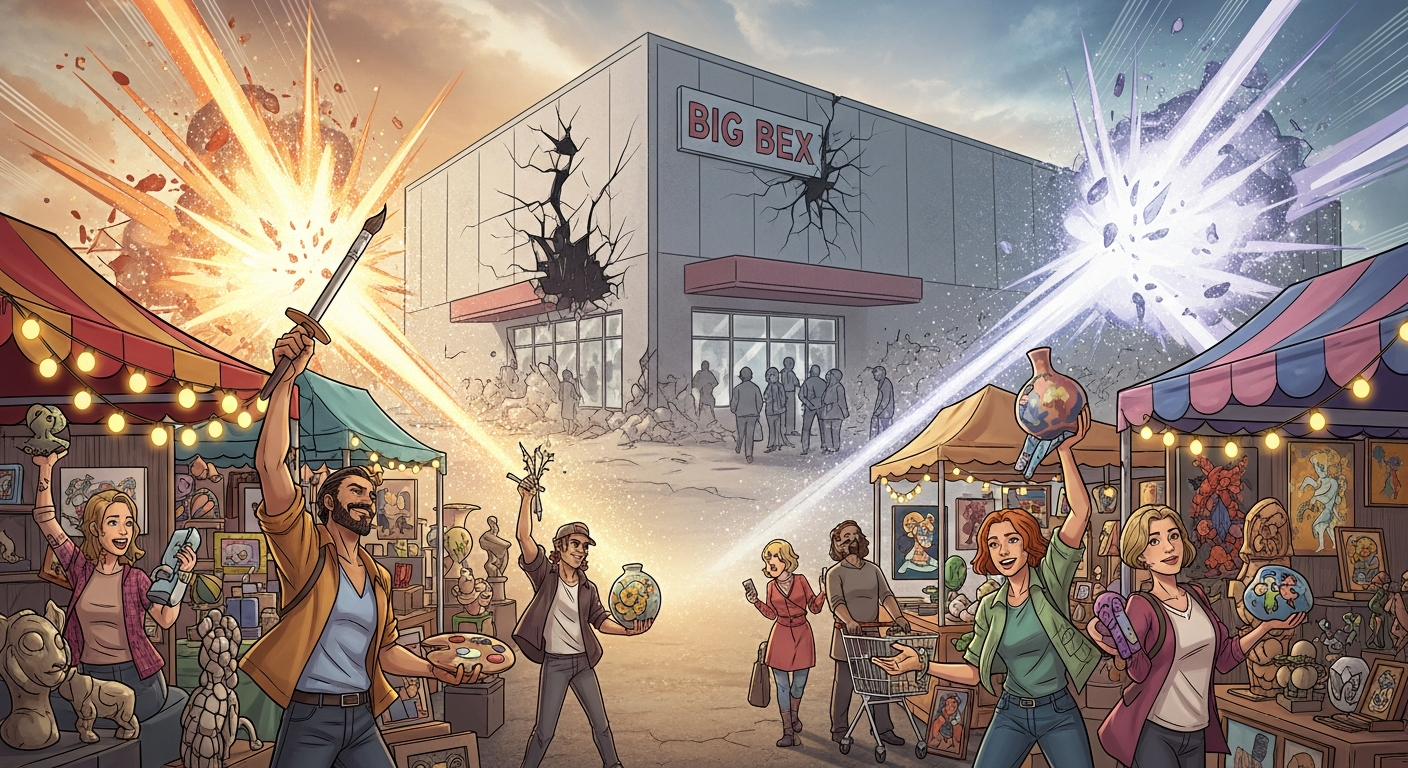
The Minnesota Merry Market at the State Fairgrounds isn’t just another holiday shopping opportunity—it represents a crucial economic and cultural counterweight to corporate retail dominance. While the National Retail Federation celebrates the milestone of holiday spending potentially exceeding $1 trillion, the real story lies in how these local art markets are reshaping community economics in ways that deserve far more attention and support.
With thousands attending daily at the Minnesota Merry Market, these aren’t merely quaint gatherings of hobbyists but powerful economic engines that keep dollars circulating locally. The 90 artists and vendors represent a microcosm of a larger movement that challenges the conventional narrative about retail and economic development.
The Multiplier Effect: Why Local Art Markets Generate More Economic Value
When consumers spend money at big-box retailers or online giants, approximately 14 cents of every dollar stays in the local economy. Contrast this with spending at local businesses and artists, where studies consistently show that 45-60 cents of each dollar recirculates locally. This ‘multiplier effect’ creates a profound economic impact that remains largely unrecognized in mainstream economic reporting.
The Minnesota Merry Market exemplifies this principle in action. Each purchase from one of the 90 vendors doesn’t merely represent a sale—it directly funds a local entrepreneur who typically spends that money at other local businesses. The American Independent Business Alliance has documented that this multiplier effect can generate up to 3.5 times more wealth for a local economy than equivalent spending at chain stores.
Consider Homespun Events itself, the organization behind the market. As a locally-focused business connecting artists with consumers, they’ve created a sustainable business model that supports hundreds of creators throughout the year. Their expansion to multiple events annually demonstrates the economic viability of this approach, contrary to the narrative that only large-scale retail can thrive.
Beyond Economics: The Cultural Infrastructure We’re Neglecting
The value of these markets extends far beyond dollars and cents. They represent critical cultural infrastructure that preserves unique regional identities in an increasingly homogenized retail landscape. When Ben Cooney, co-owner of Homespun Events, mentions they’re