Let’s cut through the dust-clouded misinformation that permeates the duct cleaning industry. Your home’s ventilation system isn’t just collecting dust—it’s harboring a microscopic ecosystem that directly impacts your health, energy bill, and property value. This isn’t speculation. This is fact.
The average American spends 90% of their life indoors, breathing recycled air pushed through metal corridors that haven’t seen daylight since installation. Your lungs are processing whatever lives in those ducts right now as you read this.
The Hidden Cost of Neglect
Your HVAC system moves 5,000 cubic feet of air per minute. When contaminated, that’s 5,000 cubic feet of particulate matter being forcibly circulated throughout your living space every sixty seconds. The EPA reports indoor air pollution levels can be two to five times higher than outdoor levels. This isn’t environmental fearmongering—it’s mathematics.
Dust accumulation reduces HVAC efficiency by up to 21%. Translation: You’re paying a premium on your energy bill to circulate contaminants more effectively throughout your home. Congratulations.
The DIY Delusion
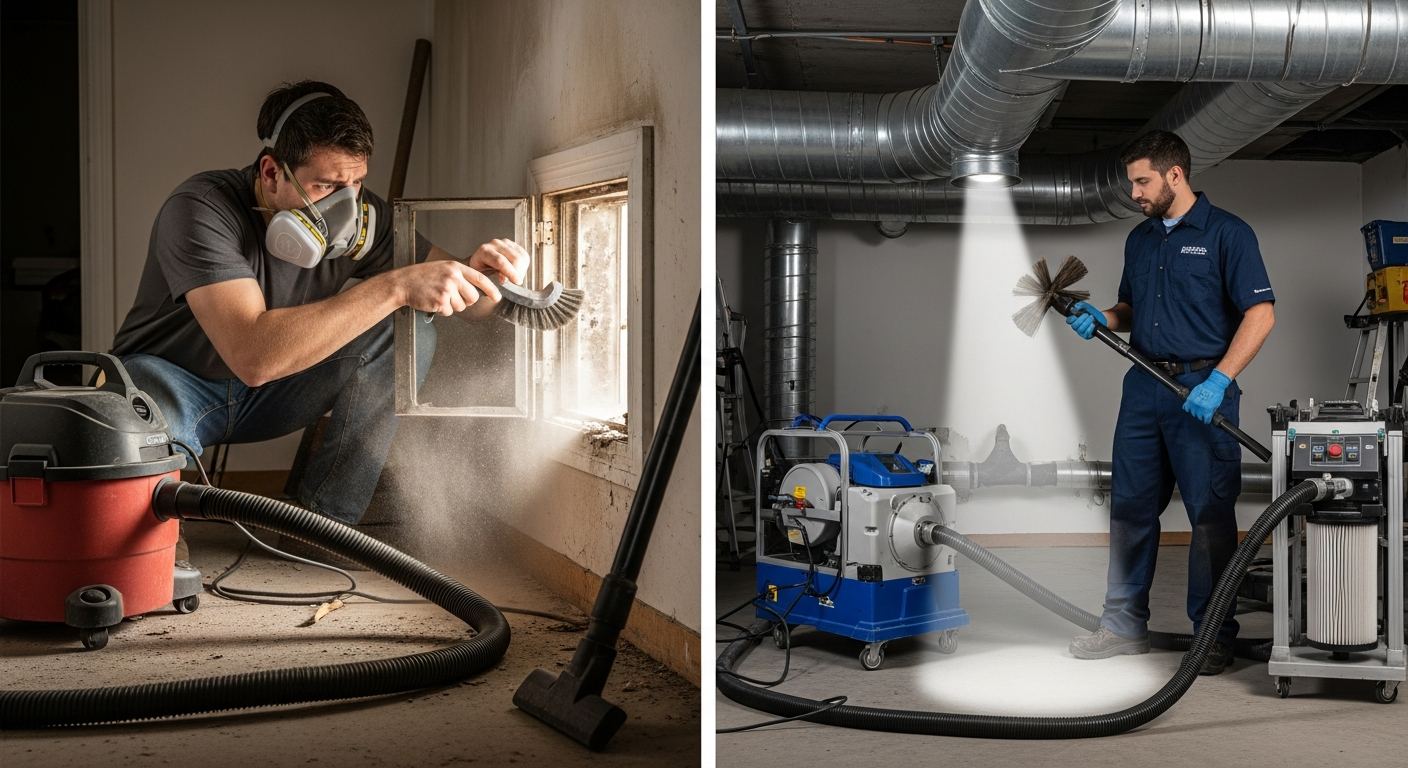
Hardware stores peddle vacuum attachments and brush kits with promises of DIY duct cleaning salvation. These tools access approximately 3-5 feet into your ductwork. The average home contains 15-20 linear feet of ductwork per room. Do the arithmetic.
Homeowner Janet Keller of Phoenix discovered this disparity firsthand. “I spent $75 on supplies and four hours crawling around my house. When I finally called professionals, they pulled out three pounds of debris my vacuum couldn’t reach.” Her DIY attempt wasn’t just ineffective—it was counterproductive, dislodging contaminants that settled deeper into the system.
When Amateur Hour Ends
Professional intervention becomes non-negotiable under specific conditions. If visible mold growth exists inside sheet metal ducts or on other components of your heating and cooling system, that’s not a weekend project—that’s a health hazard requiring certified remediation.
Rodent or insect infestation within your ductwork isn’t a situation for store-bought solutions. These infestations leave behind biohazardous materials that, when disturbed improperly, become airborne contaminants.
Excessive dust discharge from supply registers signals system-wide contamination beyond the reach of consumer-grade equipment. At this point, you’re not cleaning—you’re simply redistributing filth more evenly throughout your home.
The Professional Advantage
Certified technicians deploy negative air pressure containment—industrial-strength vacuum equipment that places your entire duct system under negative pressure. This isn’t comparable to your household Dyson; these machines extract particles at a molecular level.
Professional equipment includes mechanical brushes and air whips that navigate the entirety of your ductwork, including the remote bends and transitions that DIY tools cannot access. This isn’t about thoroughness—it’s about physics and engineering.
NADCA-certified professionals follow a strict protocol that includes inspection cameras, before-and-after documentation, and contamination removal that meets EPA standards. This isn’t excessive—it’s the baseline for actual effectiveness.
The Financial Calculation
Professional duct cleaning services range from $300-$700 depending on system size and contamination level. DIY attempts average $75-$150 in supplies with a 70% failure rate, necessitating professional intervention regardless. The math isn’t complicated.
Energy savings from properly cleaned ductwork average 11% on monthly heating and cooling costs. A $500 professional service pays for itself within 24 months through reduced utility expenses. This isn’t speculation—it’s direct ROI.
The Decision Matrix
DIY cleaning is appropriate for surface-level maintenance between professional services. If your ducts were professionally cleaned within the last three years and you’re simply addressing normal dust accumulation, consumer tools may suffice for interim maintenance.
Professional cleaning becomes mandatory when: your system has never been cleaned; visible contamination exists; you’ve completed recent construction or renovation; you’ve experienced pest infestation; or occupants suffer from unexplained respiratory issues.
This isn’t about upselling unnecessary services. This is about understanding the mechanical limitations of DIY approaches against the physical realities of enclosed ventilation systems.
The Bottom Line
Your home’s air quality isn’t a domain for half-measures and partial solutions. The decision between DIY and professional duct cleaning isn’t about capability or cost—it’s about effectiveness and health outcomes.
The air moving through your home will either sustain or undermine your health. That’s not hyperbole—that’s respiratory science. Make your decision accordingly.