
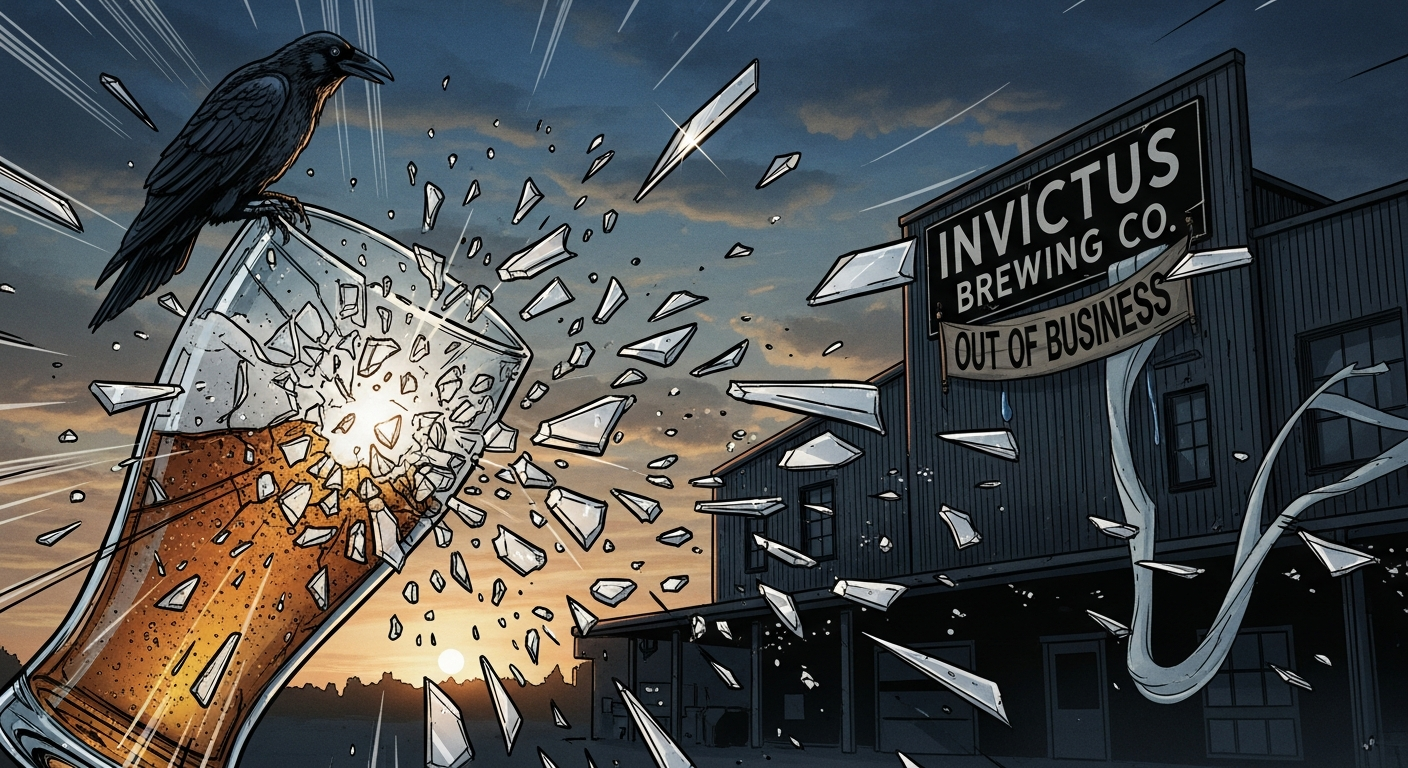
The closure of Invictus Brewing Co. in Blaine marks another chapter in what appears to be a troubling trend for Minnesota’s craft beer scene. With Wild Mind Ales, Chanhassen Brewing Company, Mankato Brewing, and partial closures of Fair State and Dangerous Man, casual observers might assume we’re witnessing the collapse of the craft beer bubble. This superficial reading misses the economic reality: what we’re experiencing isn’t a collapse but a market correction that signals the industry’s maturation.
Market Saturation Was Inevitable, Not Catastrophic
The craft brewery explosion of the 2010s was unsustainable by design. Minnesota’s brewery count more than doubled over the past decade according to the Brewers Association data. This rapid growth created a density problem, particularly in metro areas where taprooms began competing for the same limited customer base. Invictus, founded by Previn Solberg as a ‘home brewing hobby gone rogue,’ represents the passionate but sometimes economically precarious foundations of many craft breweries.
Consider the parallel with the restaurant industry, where approximately 60% of establishments fail within their first year. The surprising story isn’t that some breweries are closing—it’s that so many survived this long. Indeed’s expansion into Wisconsin and Surly’s distribution growth demonstrate that successful breweries can thrive amid this correction, but not every passion project can scale effectively.
Changing Consumer Preferences Demand Adaptation
The Gallup Poll showing fewer Americans drinking alcohol altogether represents a seismic shift that the industry must acknowledge. This isn’t merely a temporary trend but reflects deeper generational and cultural changes. The most successful breweries have already begun diversifying their offerings beyond traditional beer.
Bauhaus Brew Labs’ expansion into craft non-alcoholic beverages and Indeed Brewing’s development of THC-infused seltzers demonstrate the necessary pivot. Breweries clinging exclusively to traditional craft beer models face an increasingly challenging market reality. Fair State’s decision to close its taproom while maintaining production for retail distribution shows strategic adaptation to these changing consumption patterns.
The breweries that survive this correction will be those that recognize they’re not just in the beer business—they’re in the experience and lifestyle business, requiring diversified revenue streams and nimble business models.
Real Estate Economics Trumps Passion Projects
Invictus’ statement about selling their real estate highlights a crucial factor in brewery economics often overlooked in industry discussions. Many early craft breweries established themselves in undervalued locations that have since appreciated significantly. For founder-owned breweries, the real estate itself may have become more valuable than the brewing operation.
Bauhaus Brew Labs’ 2023 move from their original Northeast Minneapolis location to a smaller facility in St. Louis Park exemplifies this reality. Their original warehouse space had appreciated substantially, making a real estate transaction more financially beneficial than continuing operations in an oversized facility.
This pattern repeats across the country. In Portland, Oregon—once the craft beer capital—Burnside Brewing closed despite popularity when property values skyrocketed. The building’s value as condominiums or office space exceeded its value as a brewery. This isn’t market failure; it’s rational economic decision-making by brewery owners who may have gained more wealth through real estate appreciation than brewing operations could generate in decades.
Alternative Viewpoints: Is This Actually a Crisis?
Some industry analysts argue that consecutive years of brewery closings outpacing openings signals fundamental problems in the craft model. They point to changing consumer preferences, rising costs of ingredients, and distribution challenges as evidence the entire sector faces existential threats.
This perspective has merit but overestimates the significance of closure statistics. The Brewers Association data showing Minnesota still has more than twice as many breweries as a decade ago provides crucial context. What we’re witnessing isn’t industry collapse but normalization after hyper-growth. Every mature industry experiences consolidation phases where the total number of competitors decreases while the overall market stabilizes.
The more alarmist viewpoint also fails to distinguish between different brewery models. Taproom-focused breweries face different challenges than production-focused operations. Fair State’s decision to close its taproom while maintaining production and distribution demonstrates this distinction. Some business models are proving more resilient than others, suggesting evolution rather than extinction.
The Future Belongs to Specialized and Diversified Breweries
The craft beer landscape of 2025 and beyond will favor two types of operations: highly specialized niche breweries with devoted local followings and diversified beverage companies that happen to make beer. The middle ground—moderately sized breweries without distinctive offerings or alternative revenue streams—faces the greatest vulnerability.
Dangerous Man’s transition to new ownership demonstrates the potential for reinvention. Their decision to focus on production brewing rather than taproom operations shows adaptation to market realities. Similarly, Modist Brewing’s expansion into ready-to-drink cocktails represents the necessary diversification strategy.
For consumers, this maturation brings benefits despite beloved local establishments closing. The quality floor has risen dramatically as competition intensified. Today’s surviving breweries produce consistently better products than most breweries did a decade ago. The craft beer renaissance succeeded in its primary mission: dramatically improving American beer quality and diversity.
Conclusion: Creative Destruction in Action
The story of Invictus Brewing and other recent Minnesota brewery closures illustrates economist Joseph Schumpeter’s concept of creative destruction—the process by which new economic growth emerges from the dismantling of established structures. The craft brewing industry isn’t dying; it’s evolving through necessary consolidation.
For aspiring brewery owners, the lesson isn’t to abandon their dreams but to approach them with clear-eyed business fundamentals. The romanticized notion of turning a homebrewing hobby into a successful business requires more than passion—it demands strategic differentiation and financial discipline.
Minnesota’s craft beer scene will emerge stronger from this correction, with fewer but more sustainable operations delivering higher quality products. For consumers mourning favorite local taprooms, remember that creative destruction ultimately serves the customer. The breweries that survive will be those that most effectively meet consumer demands, whether through exceptional product quality, memorable experiences, or innovative offerings beyond traditional beer.