
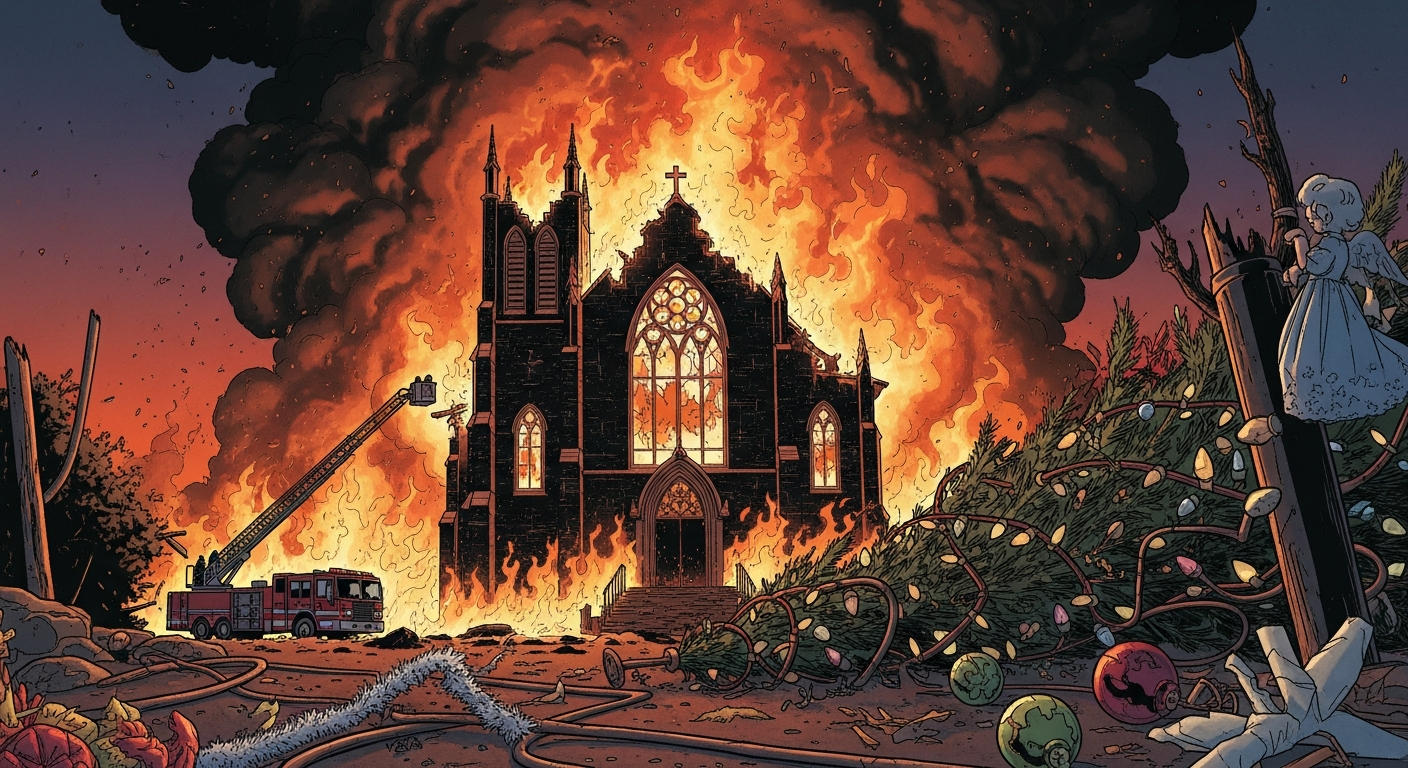
The fire that devastated Grace Slavic Church in Eagan represents far more than the destruction of a building—it illuminates the profound resilience of faith communities and challenges our materialistic understanding of what constitutes a ‘church.’ While the flames consumed irreplaceable artifacts and personal connections to the past, they simultaneously revealed something fireproof: the unbreakable human bonds that form the true foundation of religious communities.
The symbolism of the cross standing amid the destruction cannot be overlooked. It serves as a powerful reminder that the essence of faith transcends physical structures, even as we naturally mourn what has been lost. This incident offers an opportunity to reconsider what truly matters in our increasingly divided society.
Physical Structures vs. Living Communities
The devastation at Grace Slavic Church highlights an essential truth often forgotten in our building-obsessed culture: churches are fundamentally communities, not structures. The congregation’s immediate pivot to meeting at Christ Lutheran Church demonstrates this reality in action. This adaptability reflects a return to early Christian practices, when believers met in homes and public spaces rather than dedicated buildings.
Consider the example of Christchurch Cathedral in New Zealand, which was severely damaged in the 2011 earthquake. For years, the congregation worshipped in a ‘transitional cathedral’ made partly of cardboard while debates raged about rebuilding. What emerged wasn’t weakened faith but strengthened community bonds as members focused on their shared beliefs rather than architectural grandeur.
Similarly, when Chicago’s historic Pilgrim Baptist Church, designed by Louis Sullivan, was devastated by fire in 2006, the congregation continued meeting in borrowed spaces for years. The building was irreplaceable from an architectural standpoint, but the community remained intact and vibrant. These examples demonstrate that while buildings can be significant repositories of memory and tradition, they are ultimately tools for ministry, not its essence.
The Power of Interfaith Solidarity
Perhaps the most encouraging aspect of this story is the immediate response from neighboring faith communities. Christ Lutheran Church opening its doors to Grace Slavic Church represents interfaith cooperation at its finest—practical, immediate, and focused on human needs rather than theological differences.
This pattern of religious communities supporting each other through disasters has powerful precedents. After the 2018 Tree of Life Synagogue shooting in Pittsburgh, Muslim communities raised over $200,000 to support victims’ families. When Victoria Islamic Center in Texas burned in 2017, local Jewish and Christian congregations offered their buildings for Muslim worship.
These examples of interfaith solidarity stand in stark contrast to the religious tribalism that often dominates public discourse. They reveal that beneath theological differences lies a shared understanding of what it means to be a community of faith—supporting others in times of need without qualification or hesitation.
The Symbolism of the Standing Cross
The image of the cross standing amid destruction at Grace Slavic Church carries profound symbolic weight. Afanasyev’s statement—