
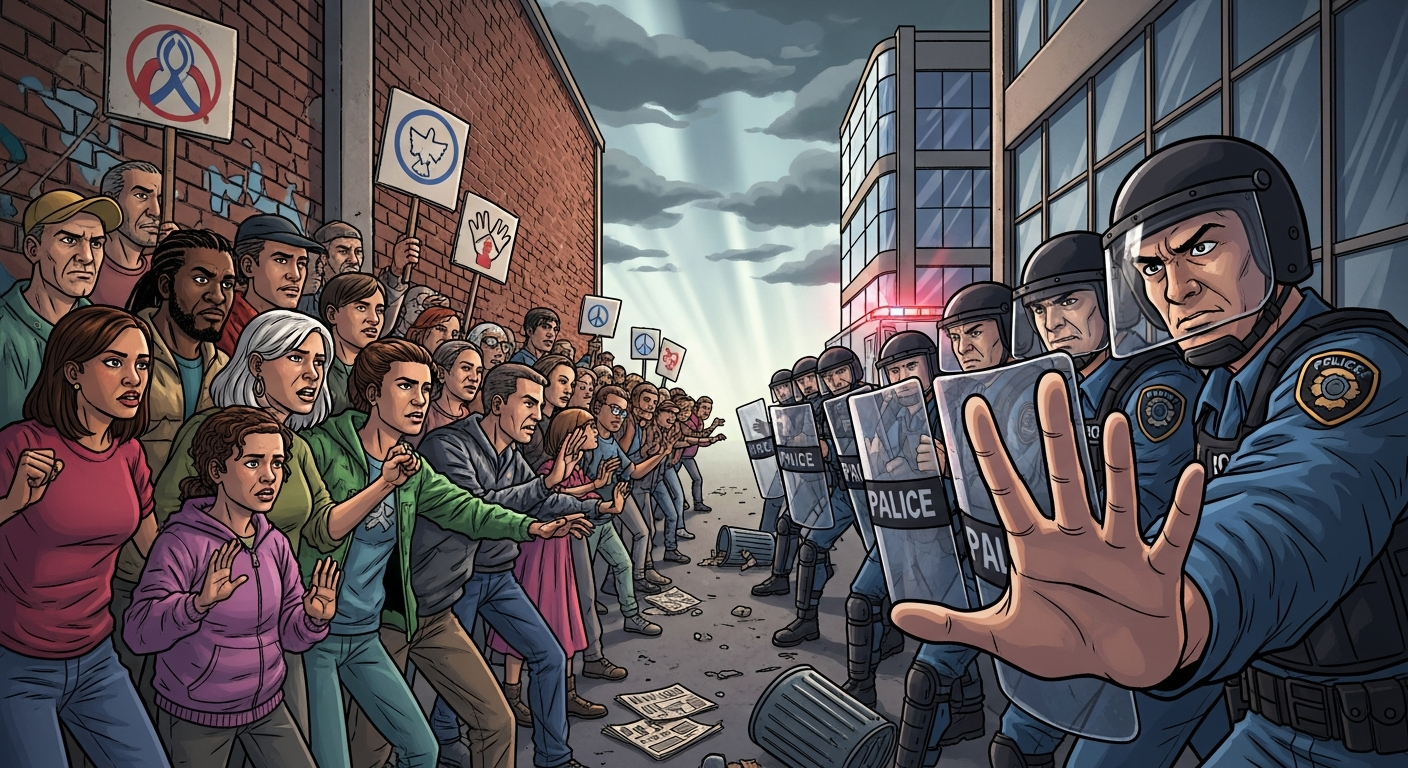
The November 25th confrontation between St. Paul police and community members protesting ICE activity represents more than just a tense moment—it exemplifies the fundamental breakdown of trust between law enforcement and the communities they claim to serve. When police officers deploy tear gas, pepper spray, and rubber bullets against unarmed protesters and journalists, they aren’t maintaining order; they’re actively undermining public safety by destroying the community relationships essential to effective policing.
Police Escalation Created the Crisis, Not Prevented It
The justification offered by Chief Axel Henry that officers responded to reports of protesters ‘arming themselves with rocks and sticks’ reflects a troubling pattern in how police departments frame their use of force. This preemptive escalation based on perceived threats—rather than documented violence—creates the very conditions for conflict they claim to prevent. The disproportionate response—deploying chemical irritants and less-lethal munitions against a crowd that included journalists and people with mobility aids—reveals a fundamental misunderstanding of de-escalation tactics.
This incident mirrors what happened in Minneapolis in 2020, where police responded to largely peaceful protests with overwhelming force, ultimately escalating tensions rather than reducing them. Research from the Armed Conflict Location & Event Data Project found that police were more likely to intervene in protests associated with the political left, and when they did intervene, those events were more likely to turn violent—suggesting that police presence and tactics often create the conditions for violence rather than preventing it.
Targeting Journalists Undermines Democratic Accountability
The targeting of three photojournalists with less-lethal munitions, as reported by the Minnesota Society of Professional Journalists, represents a direct assault on press freedom and democratic accountability. This wasn’t accidental—the journalists themselves believed they were deliberately targeted for doing their jobs. When law enforcement can operate without the scrutiny of the press, they operate without accountability to the public.
The pattern is disturbingly consistent across the country. During the 2020 protests, the U.S. Press Freedom Tracker documented over 900 press freedom violations, including physical attacks, arrests, equipment damage, and border stops. The deliberate targeting of journalists serves to remove witnesses and documentarians from scenes where police misconduct might occur, creating a chilling effect on press coverage of law enforcement activities.
Collaboration with ICE Destroys Community Trust
The St. Paul Police Department’s decision to support ICE operations fundamentally undermines their ability to protect and serve immigrant communities. When local police become entangled with federal immigration enforcement, undocumented residents become afraid to report crimes, cooperate with investigations, or seek help during emergencies. This doesn’t make communities safer—it creates shadow populations vulnerable to exploitation and crime.
Cities that have implemented sanctuary policies limiting cooperation with ICE have actually seen improvements in public safety. A study in the Proceedings of the National Academy of Sciences found that sanctuary counties have significantly lower crime rates than comparable non-sanctuary counties. This occurs precisely because these policies foster trust between immigrant communities and local law enforcement, increasing crime reporting and community cooperation.