
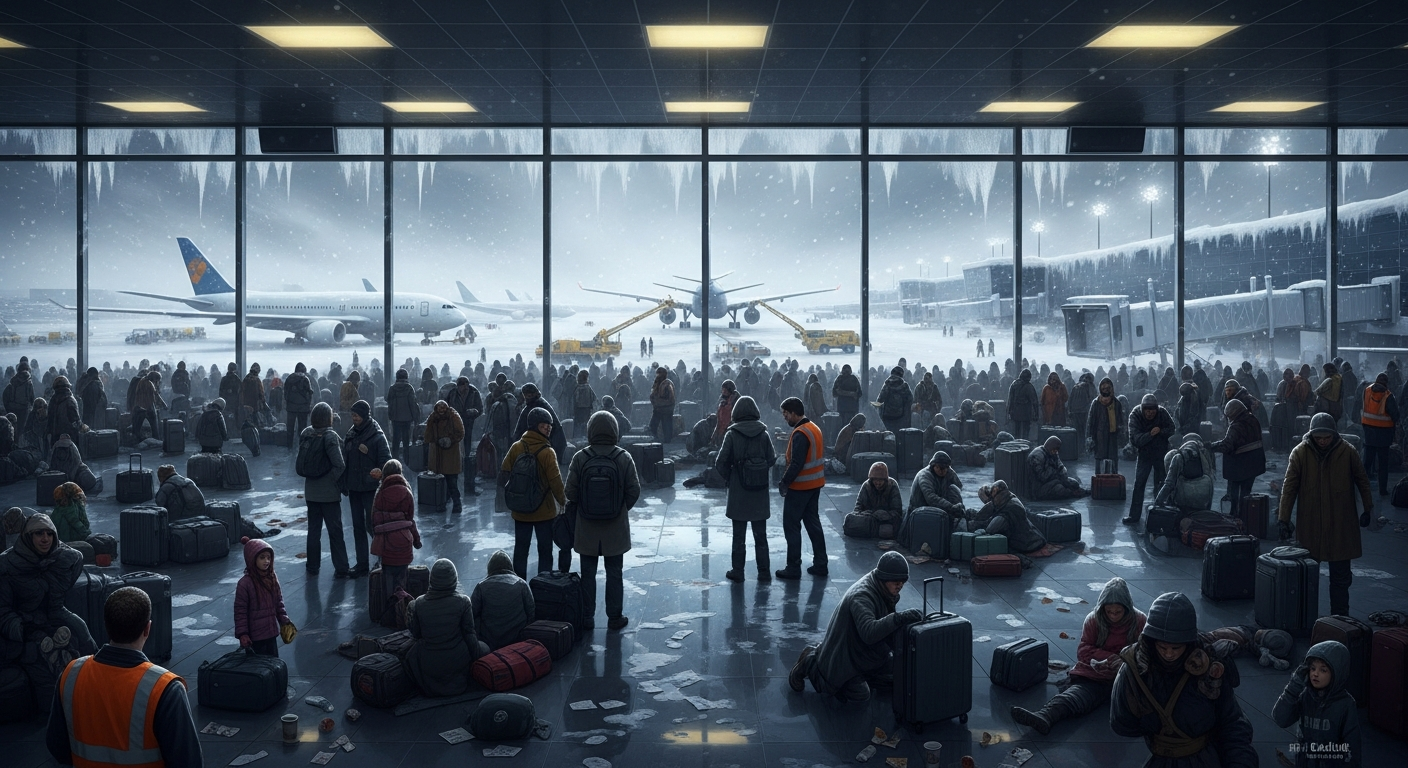
As another winter storm blankets Minnesota and causes triple-digit flight delays at MSP, we’re once again witnessing the predictable theater of weather disruption that plagues American air travel every winter. The 105-minute average delays reported at MSP aren’t just an inconvenience—they represent a systemic failure of infrastructure planning and investment that continues to cost travelers billions in lost time and productivity each year.
While weather is the immediate culprit, our acceptance of these regular disruptions reveals a deeper problem: America has normalized infrastructure inadequacy. Countries with similar or worse winter conditions manage to maintain significantly more reliable air travel through strategic investments and planning that the U.S. has consistently failed to prioritize.
Our Winter Resilience Problem Is Self-Inflicted
The scene at MSP—aircraft being sprayed with deicing fluid while passengers wait hours for departure—isn’t an inevitable consequence of winter weather. It’s the result of specific policy choices and investment priorities. Airports in Stockholm, Oslo, and Helsinki experience comparable or worse winter conditions yet maintain significantly better on-time performance during snow events.
Take Helsinki Airport as an example. Finland’s main international hub averages 101 snow days annually (compared to Minneapolis’s 37 days) yet maintains an impressive 89.4% on-time performance. Their approach includes massive investment in snow removal equipment—with capacity to clear runways in under 11 minutes—and sophisticated coordination systems that integrate weather forecasting with automated response protocols.
The contrast with American airports is stark. While MSP has made improvements in recent years, U.S. airports broadly operate with outdated equipment, insufficient staffing for winter operations, and reactive rather than proactive snow management protocols. This isn’t merely an operational difference but a philosophical one: European airports design systems assuming winter disruption, while American airports treat each snowfall as an exceptional circumstance.
The Real Costs Extend Far Beyond Delays
When officials casually report 105-minute average delays, they obscure the cascading economic impact these disruptions create. A single day of significant delays at a major hub like MSP generates ripple effects throughout the national air system, affecting hundreds of connecting flights and thousands of passengers.
According to FAA estimates, flight delays cost the U.S. economy approximately $33 billion annually in lost productivity, additional operating costs, and wasted fuel. Winter weather delays account for approximately 25% of this total—meaning we sacrifice roughly $8.25 billion yearly to a problem that has proven technological solutions.
Beyond the macroeconomic impact, these delays represent real human costs: missed business opportunities, shortened family visits, and the stress of unpredictable travel. A 2019 study by the American Psychological Association found that travel disruptions rank among the top five stressors during holiday periods, contributing to significant mental health impacts.
The Technology Gap Is Widening
What makes America’s winter airport performance particularly frustrating is that solutions exist and are being implemented elsewhere. Automated runway assessment vehicles in Zurich can evaluate surface conditions in minutes rather than hours. Montreal-Trudeau Airport employs centralized deicing facilities that process aircraft with assembly-line efficiency. Tokyo’s Narita Airport uses heated runway systems that prevent snow accumulation in the first place.
Meanwhile, American airports still rely predominantly on manual inspections, decentralized deicing procedures, and reactive snow removal. MSP’s deicing process—while improved from previous decades—still requires each aircraft to be individually sprayed at the gate or deicing pads, creating inevitable bottlenecks during snowfall events.
The technology gap isn’t just about equipment but about systems integration. Modern winter-ready airports use predictive analytics to deploy resources before storms hit, coordinating everything from staff scheduling to chemical application rates based on forecast models. These systems reduce the guesswork that still characterizes American winter operations.
Alternative Viewpoint: Weather Is Simply Unpredictable
Defenders of the status quo argue that weather, by its nature, creates unavoidable disruptions that no amount of preparation can fully mitigate. They point to extreme events that would challenge even the most sophisticated systems and suggest that occasional delays are simply the price of operating in variable climates.
This perspective has merit in extreme cases. The polar vortex events or once-in-a-decade ice storms genuinely exceed design parameters of most infrastructure. However, the regular winter storms that cause predictable delays each season in Minneapolis, Chicago, and other northern hubs are precisely the conditions that modern aviation infrastructure should be designed to handle.
The unpredictability argument also fails to explain why airports with similar weather patterns achieve dramatically different reliability metrics. If Denver International Airport can maintain significantly better winter performance than Chicago O’Hare despite comparable snowfall, the difference isn’t weather—it’s infrastructure design and operational priorities.
The Path Forward Requires Investment and Political Will
Addressing America’s winter air travel reliability problem requires both immediate operational improvements and long-term infrastructure investment. In the short term, airports like MSP could implement centralized deicing facilities, expand snow removal capacity, and adopt more sophisticated weather response protocols without major capital projects.
The longer-term solution demands significant infrastructure investment—the kind that other developed nations have prioritized while America’s aviation infrastructure has aged. The American Society of Civil Engineers consistently rates U.S. aviation infrastructure as barely passing, with a D+ grade in their most recent infrastructure report card.
Congress has repeatedly failed to fully fund the Airport Improvement Program, leaving critical modernization projects unfunded or delayed. The 2021 infrastructure bill, while providing some aviation funding, allocated just a fraction of what experts estimate is needed to bring American airports to modern standards.
The situation at MSP—where passengers sit on tarmacs watching deicing fluid being sprayed in the same basic manner it was 30 years ago—reflects this broader national failure to prioritize infrastructure that works in all seasons, not just fair weather.
Conclusion: Winter Delays Reflect Our Priorities
The 105-minute delays at MSP during this winter storm aren’t acts of God or unavoidable consequences of geography. They’re the predictable result of infrastructure choices that prioritize short-term cost savings over system resilience and passenger experience.
Until Americans demand the same level of winter performance from our aviation system that travelers in Scandinavia, Japan, and Canada receive, we’ll continue experiencing these seasonal disruptions as if they’re inevitable rather than solvable problems. The technology exists. The operational models are proven. What’s missing is the political will to invest in infrastructure that works reliably in all seasons—not just when the sun shines.