
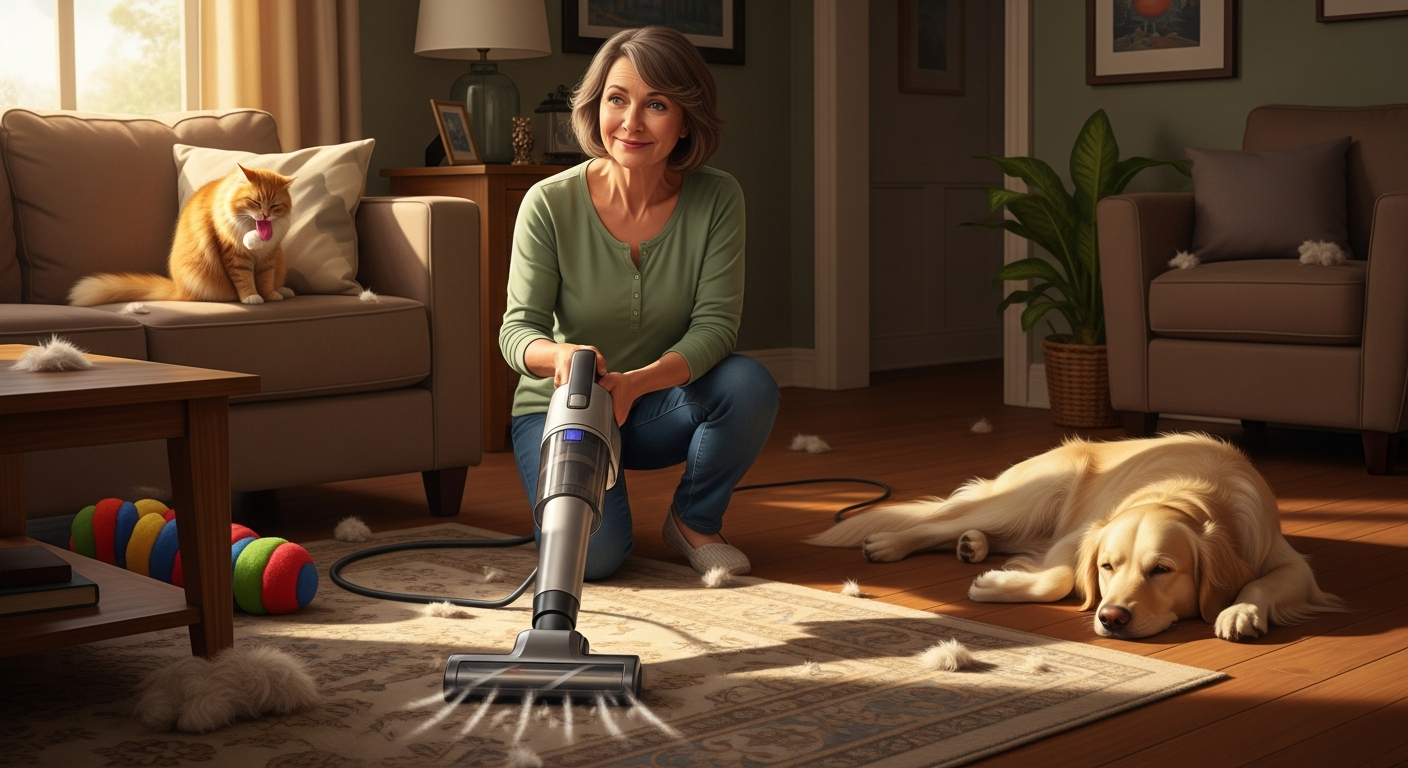
The American love affair with pets has always existed in tension with our equally fervent devotion to pristine domestic spaces. In living rooms across the country, lint rollers stand as monuments to this cultural contradiction—our desire to keep both beloved shedding companions and immaculate furniture. According to the American Pet Products Association, nearly 70 percent of U.S. households include at least one pet, representing a collective national decision that companionship outweighs cleanliness. Yet the eternal battle against fur tumbleweeds suggests we haven’t fully reconciled ourselves to this trade-off.
The Evolutionary Paradox of Pet Hair
Pet fur represents a peculiar modern dilemma. Throughout most of human history, animals lived alongside us in utilitarian arrangements—cats caught vermin, dogs guarded property. Their shedding was an unremarkable fact of life, like mud or dust, simply part of the environment. Today’s pet owners, however, inhabit a world transformed by post-WWII domestic ideals, where spotless homes signal moral virtue and self-discipline.
“We’ve developed these impossible standards of cleanliness that no household with animals could ever maintain,” explains Dr. Eleanor Wilkins, cultural anthropologist at the University of Michigan who studies human-animal relationships. “Pet owners experience a kind of cognitive dissonance—loving their animals while simultaneously fighting against the most natural evidence of their presence.”
This dissonance has spawned an entire industry of specialized cleaning products, from electrostatic mops to air purifiers designed specifically for dander. Americans spend over $400 million annually on pet hair removal products alone, according to market research firm Nielsen—a figure that reflects not just practical necessity but our psychological relationship with domestic space.
The Microbiome Revolution
Interestingly, as pet owners wage war against visible fur, emerging science suggests the invisible microbiome of our animal companions may actually benefit human health. Studies from the University of Arizona’s Department of Veterinary Science indicate that homes with pets harbor more diverse bacterial ecosystems, potentially strengthening residents’ immune systems and reducing allergy risks for children.
“We’re learning that an obsessively clean home might not be the healthiest environment,” says immunologist Dr. Rajiv Patel. “The microorganisms pets bring indoors may create a more robust immune response in humans. The fur you can see isn’t necessarily the problem—it’s our perception of it as inherently unclean.”
This research challenges conventional wisdom about keeping a clean home, suggesting that our focus on eliminating all traces of our pets may be misguided. The most effective approach might involve strategic cleaning rather than constant vigilance—addressing genuine health concerns like allergen accumulation while accepting some level of visible fur as the reasonable cost of interspecies cohabitation.
Practical Harmonies: Beyond the Lint Roller
For those seeking a middle path between surrender and constant cleaning, interior designers who specialize in pet-friendly homes recommend thoughtful adaptations rather than futile resistance. “Smart pet owners design around their animals rather than against them,” says Melanie Chen, whose San Francisco design firm specializes in pet-compatible interiors. “This means selecting furniture fabrics that don’t attract fur, installing washable slipcovers, and choosing floor coverings that hide rather than highlight shedding.”
The most successful strategies often involve preventative measures rather than remedial cleaning. Regular grooming significantly reduces household shedding—a fact veterinarians have emphasized for decades but which many owners neglect. Professional groomer Tasha Williams notes that “ten minutes of brushing outdoors three times weekly can reduce indoor fur accumulation by nearly 60 percent. Yet most clients only bring their pets in when shedding has already overwhelmed their homes.”
Technology offers increasingly sophisticated solutions as well. Robotic vacuums programmed to run daily maintain baseline cleanliness, while advanced HVAC filters capture airborne particles before they settle. These tools don’t eliminate the need for occasional deep cleaning but create a sustainable maintenance system that accommodates both human aesthetics and animal realities.
The Philosophical Dimension of Fur
Perhaps the most profound approach to the fur dilemma involves neither new cleaning technologies nor design strategies, but a philosophical recalibration. The presence of pet fur represents not disorder but evidence of a meaningful cross-species relationship—one that enriches human life in ways that sterile perfection cannot.
“When I interview elderly pet owners, they often express that they’ve made peace with fur,” says sociologist Dr. Amara Jackson, who studies aging and animal companionship. “They’ve recognized that the joy their animals bring far outweighs the inconvenience of cleaning. There’s wisdom in that perspective—a kind of prioritization that comes with life experience.”
This wisdom suggests that keeping a truly clean home with pets isn’t about elimination but integration—finding ways to incorporate animal companionship into our domestic lives without surrendering either comfort or hygiene. The most successful pet owners develop cleaning routines that address genuine concerns while accepting that perfection is neither possible nor necessary.
In the end, the tumbleweeds of fur that drift across our floors might be viewed not as failures of domestic management but as physical manifestations of the love that fills our homes—tangible reminders that we’ve chosen connection over perfection, companionship over spotlessness. In a culture that increasingly values authenticity over appearance, perhaps the fur-covered home represents not defeat but a more honest way of living—one that acknowledges the beautiful mess of sharing our lives with creatures unlike ourselves.