
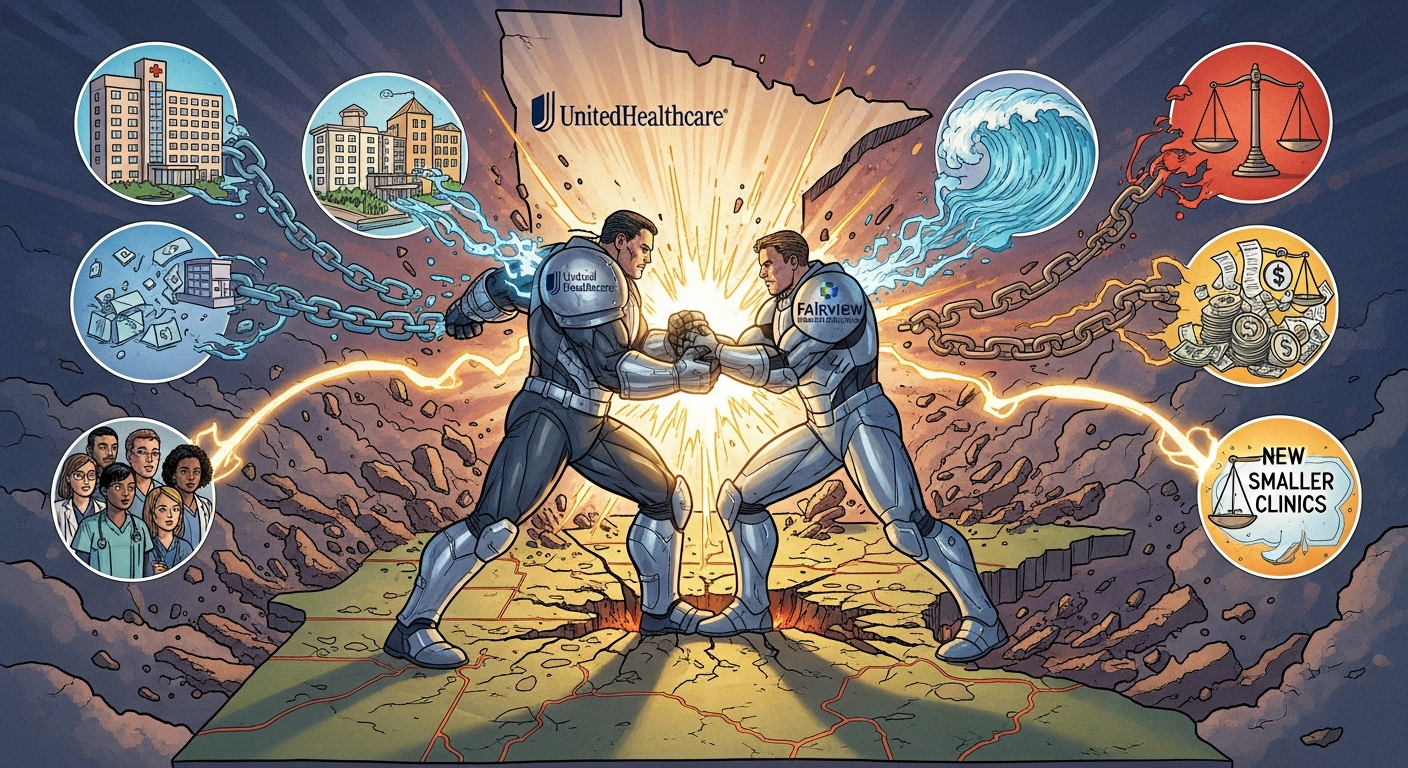
The eleventh-hour agreement between UnitedHealthcare and M Health Fairview represents a collective sigh of relief for thousands of Minnesota patients who faced the prospect of losing access to their trusted healthcare providers. While both organizations frame this as a victory, this last-minute deal exposes the fundamental dysfunction of America’s healthcare system – one where patients are repeatedly held hostage in corporate negotiations they have no control over.
The tentative contract extending through 2028 means patients with UnitedHealthcare plans can continue seeing their Fairview providers without disruption. This outcome is certainly preferable to the alternative, but it masks a deeper problem: the continued consolidation of healthcare power that leaves patients and providers at the mercy of profit-driven insurance giants.
Corporate Healthcare Negotiations Routinely Endanger Patient Care
The fact that thousands of patients faced uncertainty about continued care until the final hour is not an anomaly – it’s becoming standard practice in American healthcare. These high-stakes corporate showdowns happen with alarming regularity across the country. In 2023 alone, similar standoffs occurred between Anthem Blue Cross and Cedars-Sinai in California, Cigna and HCA Healthcare in Florida, and Humana and Baylor Scott & White in Texas.
Each time, patients are treated as pawns in a chess match between massive healthcare conglomerates. Fairview’s statement about achieving “fair, market-aligned reimbursement” reveals the true nature of these negotiations – they’re primarily about money, not patient care. While both parties celebrate the resolution, neither addresses the fundamental problem: a system where insurance companies wield enormous power to dictate terms to healthcare providers, who then must choose between accepting unfavorable reimbursement rates or losing patients.
Insurance Consolidation Creates Dangerous Power Imbalances
UnitedHealth Group isn’t just an insurance company – it’s a healthcare behemoth with $324.2 billion in revenue in 2022, making it the largest healthcare company in the world by revenue. Through its Optum division, it employs or contracts with over 70,000 physicians nationwide. This vertical integration gives UnitedHealthcare enormous leverage in negotiations with hospital systems like Fairview.
The Minnesota situation reflects a nationwide trend of insurance consolidation. Just four companies – UnitedHealth, Anthem, Cigna, and Humana – control approximately 46% of the national insurance market. In many regional markets, a single insurer may control 80% or more of available plans. This concentration of power means providers have few alternatives when negotiating with dominant insurers in their region.
The American Medical Association has documented how this consolidation correlates with higher premiums for consumers and lower reimbursements for providers. A 2023 AMA study found that in 43% of metropolitan areas, a single insurer had at least a 50% market share. This monopolistic control allows insurers to dictate terms while patients and providers bear the consequences.
Administrative Burdens Represent Hidden Healthcare Costs
Fairview’s statement mentioned reducing “administrative red tape that delays care” as a key negotiation point. This highlights another systemic problem – the enormous administrative burden that insurance requirements place on healthcare systems. A 2022 JAMA study estimated that administrative costs account for 34.2% of all healthcare expenditures in the United States, totaling approximately $1.1 trillion annually.
These costs stem directly from the complex web of insurance requirements, prior authorizations, and billing procedures that providers must navigate. The average physician practice spends 12.5 hours per week on insurance-related administrative tasks – time that could be spent on patient care. For hospital systems like Fairview, these administrative requirements necessitate entire departments dedicated to insurance compliance.
The fact that reducing this bureaucracy was a key negotiation point underscores how insurance requirements actively impede efficient healthcare delivery. Patients experience these burdens as delayed care, denied claims, and the frustration of navigating a system designed to create barriers rather than facilitate treatment.
Alternative Viewpoints: The Case for Managed Care Oversight
Defenders of the current insurance system argue that insurers play a necessary role in controlling healthcare costs. They point to studies showing that managed care can reduce unnecessary procedures and promote evidence-based medicine. Insurance companies claim their authorization requirements prevent wasteful spending and ensure appropriate care.
There is merit to the argument that some form of utilization management is necessary in a fee-for-service environment where providers have financial incentives to deliver more services. However, the current system has clearly overcorrected, creating administrative burdens that far exceed any potential savings from prevented unnecessary care.
Moreover, the profit motive of private insurers fundamentally misaligns incentives. UnitedHealth Group reported $20.1 billion in profit in 2022 – money extracted from the healthcare system that could have funded actual care. When insurance companies answer primarily to shareholders rather than patients, their decisions will inevitably prioritize financial returns over healthcare outcomes.
Moving Beyond the Current Broken System
The UnitedHealthcare-Fairview agreement represents a Band-Aid on a gushing wound. While patients can temporarily breathe easier, the fundamental problems remain unaddressed. True reform would require addressing the monopolistic power of insurance giants, reducing administrative waste, and realigning incentives toward patient care rather than profit extraction.
Countries with universal healthcare systems avoid these recurring crises entirely. In the UK, Canada, and Germany, patients never face losing access to their doctors because of corporate contract disputes. These systems have their own challenges, but they prioritize continuous patient access to care as a fundamental principle rather than a negotiable contract term.
Even short of systemic reform, stronger regulations could protect patients from being used as leverage. States like California have implemented continuity of care laws that require insurers to maintain coverage for certain patients even when network contracts expire. Federal legislation could establish similar protections nationwide and limit the ability of insurers to terminate provider contracts without substantial notice periods.
The Path Forward Requires Structural Change
The tentative agreement between UnitedHealthcare and Fairview represents the best possible outcome within a fundamentally flawed system. Patients will maintain access to their providers, which is unquestionably good news. But celebrating this outcome without acknowledging the dysfunction that created the crisis in the first place merely perpetuates the cycle.
Real progress would require addressing the concentration of power in the insurance industry, dramatically reducing administrative waste, and reorienting the entire system around patient needs rather than corporate profits. Until then, patients across Minnesota and the nation will continue to be held hostage by corporate negotiations they have no part in but whose outcomes determine their access to essential healthcare.
The relief felt today will inevitably give way to the next contract dispute, the next network narrowing, and the next crisis of access. The question isn’t whether another healthcare system and insurer will reach an impasse – it’s simply which ones and when. And once again, patients will bear the burden of a system that treats their care as a negotiable commodity rather than a fundamental right.