
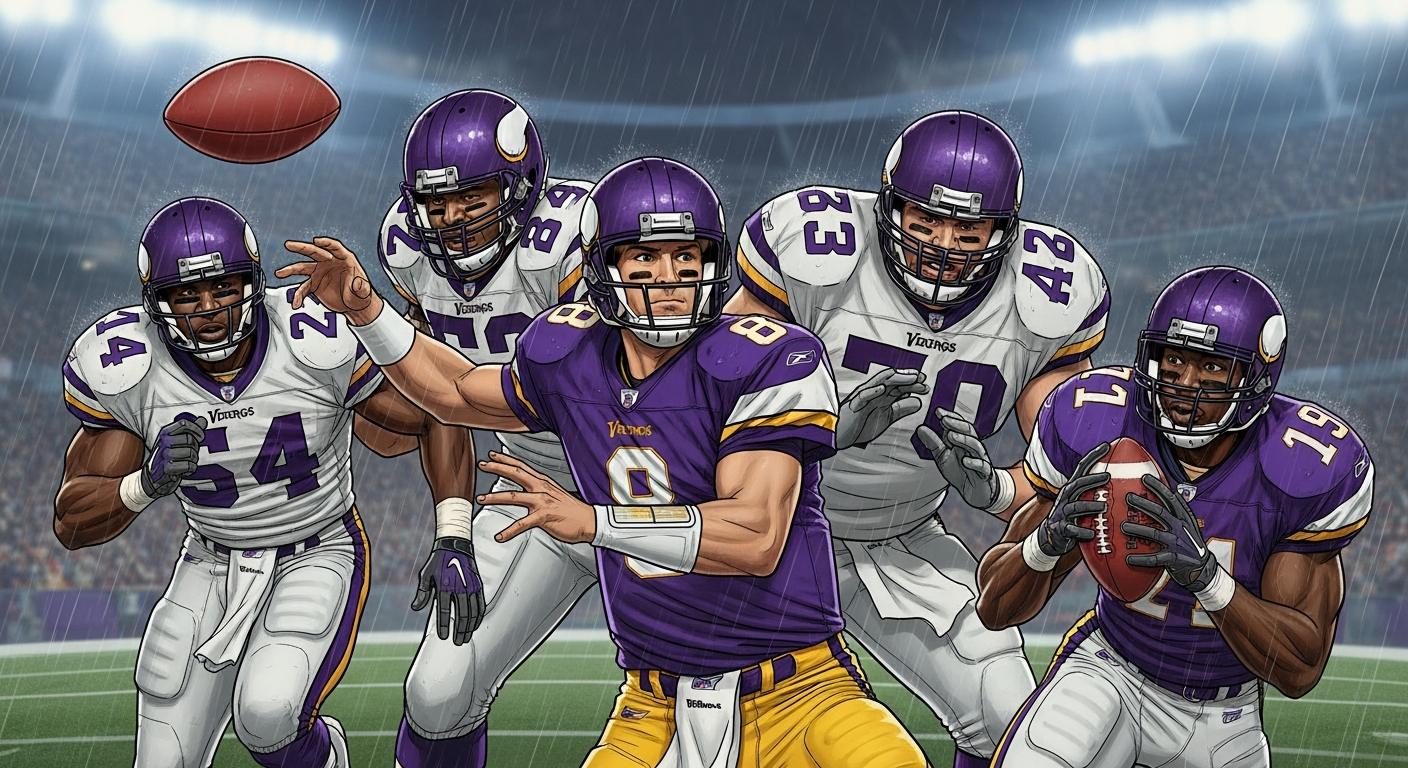
The Minnesota Vikings’ 98-yard touchdown drive against their opponents wasn’t just impressive—it was historic. When rookie quarterback J.J. McCarthy engineered a 19-play masterpiece that consumed 12 minutes of game clock, he didn’t just score points; he announced his arrival as the franchise quarterback the Vikings have desperately sought. This methodical march down the field, the team’s longest since at least 2000, revealed something far more significant than a single scoring drive. It demonstrated McCarthy’s poise, decision-making, and ability to perform under pressure—qualities that separate developmental prospects from true franchise cornerstones.
McCarthy’s Third-Down Mastery Shows Elite Mental Processing
The most telling aspect of McCarthy’s performance wasn’t the yardage total but his third-down execution. Converting three critical third downs—including a third-and-6 near his own goal line where he escaped pressure and gained seven yards—showcased a quarterback who processes information at an elite level. This isn’t just about athletic ability; it’s about football intelligence. When McCarthy found Jordan Addison for 21 yards on third-and-8 and later connected with Justin Jefferson for 13 yards on third-and-12, he demonstrated the situational awareness that many veteran quarterbacks still struggle to develop.
Compare this to other rookie quarterbacks this season. While Caleb Williams has flashed brilliance with the Bears, his third-down conversion rate has hovered around 33%, well below league average. Drake Maye in New England has shown similar growing pains in critical situations. McCarthy’s ability to sustain drives by making the right reads under pressure puts him in rare company among first-year signal-callers.
The Drive Validates Minnesota’s Draft Strategy
When the Vikings selected McCarthy in the first round, many analysts questioned whether they’d overdrafted him. This historic drive serves as powerful evidence that Minnesota’s front office got it right. The 19-play drive wasn’t just about McCarthy’s arm talent—it demonstrated his complete skill set. His willingness to use his legs when necessary (the critical 7-yard scramble), his accuracy in tight windows, and his chemistry with both established stars like Jefferson and emerging talents like Addison all point to a quarterback who can be the centerpiece of this offense for years to come.
The Vikings’ decision looks especially prescient when compared to the Denver Broncos’ selection of Bo Nix. While Nix has shown flashes, he hasn’t demonstrated the same level of poise in extended drives. McCarthy’s performance reinforces that quarterback evaluation isn’t just about physical tools but about the mental processing and leadership qualities that are much harder to measure at the combine.
Time of Possession: The Overlooked Game-Changer
The 12-minute drive—the first of its kind in the NFL in four years—highlights an underappreciated aspect of McCarthy’s impact: his ability to control game tempo. In today’s NFL, where high-octane offenses often score quickly, the ability to orchestrate methodical drives provides a massive competitive advantage. It keeps your defense rested and the opposing offense cold on the sideline.
The Kansas City Chiefs’ Super Bowl success under Andy Reid and Patrick Mahomes has often been attributed to their explosive plays, but their ability to control clock when necessary has been equally important. McCarthy’s demonstrated ability to lead extended drives puts him in the company of established veterans like Mahomes, Joe Burrow, and Josh Allen—quarterbacks who can win in multiple ways depending on what the game demands.
The statistics bear this out. Teams that win the time of possession battle win approximately 68% of NFL games. McCarthy’s ability to engineer extended drives could become Minnesota’s secret weapon in close contests, especially in the playoffs where each possession carries enormous weight.
Alternative Viewpoints: Is One Drive Too Small a Sample Size?
Critics might reasonably argue that a single drive—even a historic one—is too small a sample size to draw sweeping conclusions about McCarthy’s future. After all, NFL history is littered with quarterbacks who showed early promise only to flame out. Robert Griffin III’s spectacular rookie season with Washington gave way to injury problems and inconsistency. Baker Mayfield looked like Cleveland’s savior before inconsistency led to his departure.
Additionally, McCarthy benefited from having elite weapons at his disposal. Justin Jefferson is arguably the NFL’s best receiver, and Jordan Addison has emerged as a dangerous complementary threat. Many young quarterbacks would look good throwing to such talented targets.
These are valid concerns, but they overlook crucial context. McCarthy’s performance wasn’t just about completing passes to open receivers. It was about maintaining composure when backed up at his own 2-yard line, making correct pre-snap reads, and delivering accurate throws in high-pressure third-down situations. These skills translate regardless of supporting cast and suggest McCarthy possesses the fundamental quarterback traits that lead to sustained success.
The Bigger Picture: What This Means for Minnesota’s Future
The Vikings’ investment in McCarthy wasn’t just about finding a quarterback—it was about establishing a new identity. Under previous quarterback Kirk Cousins, Minnesota had a ceiling. They could make the playoffs, even win a game, but never seemed capable of making a deep run. McCarthy’s emergence suggests the ceiling has been raised significantly.
With McCarthy demonstrating poise beyond his years, the Vikings can now build around a quarterback on a rookie contract—the model that has helped teams like the Eagles, Chiefs, and Bengals reach Super Bowls in recent years. This financial flexibility, combined with McCarthy’s evident talent, opens a championship window that simply didn’t exist with Cousins’ massive contract on the books.
The 98-yard drive doesn’t just represent a touchdown in one game—it represents the beginning of a new era in Minnesota football. An era where the Vikings aren’t just competitive, but potentially dominant. An era where January football becomes the expectation rather than the hope. McCarthy’s historic march down the field may well be remembered as the moment when Minnesota’s fortunes truly changed.